When you plug in an appliance at home you rarely stop to think about the safety checks it has gone through. Behind every reliable product is a strict set of standards ensuring it won’t harm you or your family.
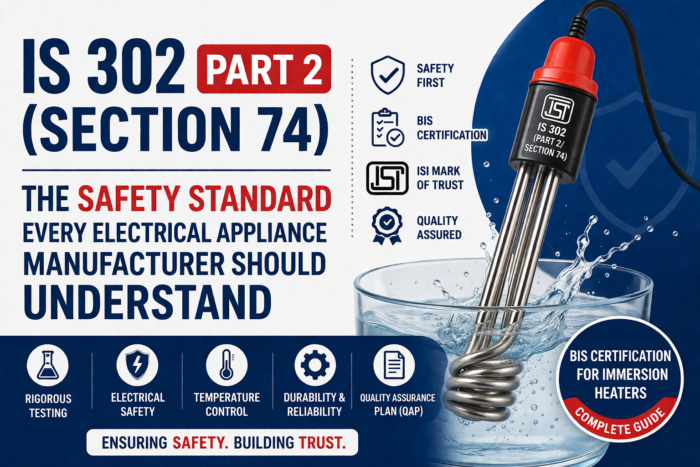
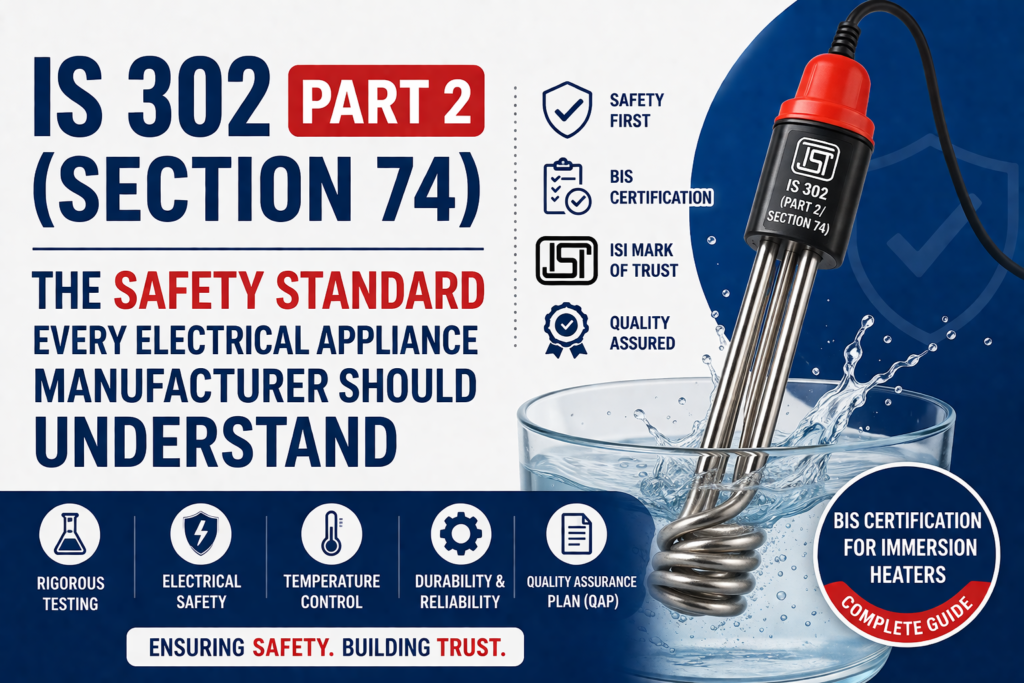
One such important standard in India is IS 302 Part 2 issued by the Bureau of Indian Standards (BIS). If you’re a manufacturer, importer or even a curious consumer understanding IS 302 Part 2 standard can give you a picture of how electrical safety is maintained in India.
Let’s break it down in a practical way.
What Exactly is IS 302 Part 2?
Think of IS 302 as a rulebook for appliance safety.
- Part 1 covers general safety rules that apply to all appliances
- Part 2 goes deeper into products adding detailed requirements
These standards are aligned with global norms set by the International Electrotechnical Commission making Indian products competitive and safe by international standards.
Section 74 – Portable Immersion Heaters
We’re focusing on Section 74 – Portable Immersion Heaters.
Why Focus on Immersion Heaters?
Immersion heaters are simple widely used and honestly—a bit risky if not made properly. They directly interact with water and electricity at the time, which is why strict safety rules are non-negotiable.
According to the BIS manual:
- IS 302 (Part 2/Section 74): 2024 defines safety requirements for portable immersion heaters
- It is harmonized with IEC 60335-2-74: 2021
There’s also a compliance shortcut:
If a manufacturer already complies with IS 368: 2014 the requirements of IS 302 Part 2 Section 74 are considered fulfilled.
BIS Certification: What Manufacturers Need to Know
Before selling immersion heaters in India manufacturers must get BIS certification under Scheme-I.
This isn’t paperwork—it’s a full validation process.
The license typically includes:
- Product type (Immersion Heater)
- Model numbers
- Power rating (Wattage)
- Voltage & frequency
- Appliance class (Class I, II, III)
- Type of supply (AC/DC)
In terms every variation of your product must be accounted for.
How Testing Actually Works
Let’s make this practical.
Sample Requirement: 2 units are required for testing
Smart Grouping System: To reduce testing load BIS allows grouping based on:
- Power (≤1000W or above)
- Type of supply (AC/DC)
Usually the highest wattage model is. The results apply to the whole group. This saves time and cost—an advantage for manufacturers.
Safety Tests
Now the important part—how safety is actually checked.
Here are the major tests explained in language:
- Protection Against Electric Shock: Ensures no live parts are exposed during usage.
- Current Test: Checks if the appliance consumes power within safe limits.
- Temperature Rise Test: Makes sure the heater doesn’t overheat dangerously.
- Moisture Resistance: Because water + electricity = risk this test is critical.
- Fire & Heat Resistance: Ensures materials don’t catch fire easily.
- Mechanical Strength: Tests durability against drops or rough handling.
- Abnormal Operation Test: Simulates misuse scenarios (like running dry).
Do You Need a Lab Setup?
Not necessarily.
Manufacturers have options:
- In-house testing lab
- Shared testing facilities
- BIS-approved labs
- ISO/IEC 17025 accredited labs
This flexibility makes compliance more accessible for small businesses.
Quality Assurance Plan (QAP): The Backbone of Compliance
Getting certified is the beginning.
You also need a Quality Assurance Plan (QAP) which means:
- testing during production
- Defining batches (daily production)
- Keeping test records
- Ensing consistency across all units
Think of it as a discipline system for quality.
ISI Mark: More Than Just a Logo
Once approved your product gets the ISI mark—a trust symbol in India.
There’s a catch:
- It must be clearly and permanently marked
- Only compliant products can carry it
- Instructions must be provided with every unit
Misuse of the mark can lead to legal consequences.
What Happens to Defective Products?
BIS is strict here.
- Non-compliant products must be properly disposed of
- They cannot be sold under any circumstances
This ensures that unsafe products never reach consumers.
Testing Frequency: Not One-Time
Testing isn’t a one-time activity.
Some tests are done:
- Daily (safety checks)
- Weekly (performance tests)
- Half-yearly (advanced safety tests)
This continuous monitoring is what keeps product quality consistent.
Why IS 302 Part 2 Matters??
Let’s be honest—this standard isn’t about compliance.
For Manufacturers:
- Builds credibility
- Reduces product failure risk
- Helps enter markets
For Consumers:
- Prevents electric shocks and accidents
- Ensures performance
- Builds trust in brands