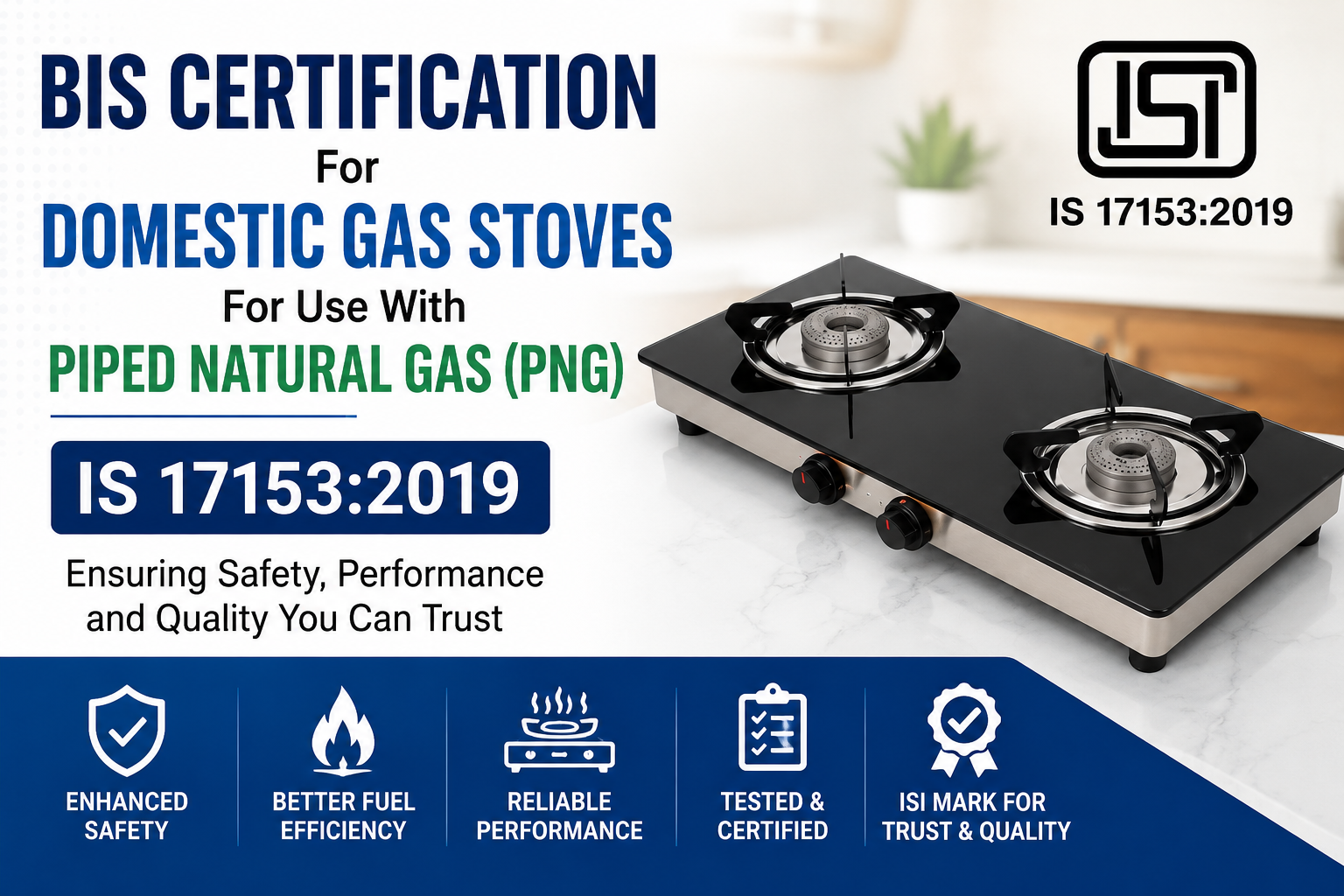

More and more people in India are switching from LPG cylinders to Piped Natural Gas (PNG) for their homes. This means that the demand for efficient Domestic Gas Stoves that use Piped Natural Gas (PNG) is going up really fast. With this increase in demand manufacturers have a big responsibility to make sure that every gas stove they sell is safe and good quality.
This is where BIS Certification under IS 17153:2019 comes in. The Bureau of Indian Standards (BIS) says that all Domestic Gas Stoves that use Piped Natural Gas (PNG) must follow the Indian Standard IS 17153:2019 and have the ISI Mark before they can be sold in India. This standard is about safety, performance and how well the stove uses gas to protect people from things like gas leaks and fires.
What is IS 17153:2019?
It is the Indian Standard that lists the requirements for Domestic Gas Stoves that are designed to work with Piped Natural Gas (PNG). This standard covers things like how the stove’s built, how well the burner works and how safe the ignition is. It also talks about how efficient the stove’s how it is tested.
Domestic Gas Stoves that use Piped Natural Gas (PNG) are different from those that use LPG. They work at pressure levels and need different burner setups. So manufacturers have to make sure that their products are designed and tested to work with Piped Natural Gas (PNG).
The standard also includes rules about things like:
- How stable the flame is
- Preventing gas leaks
- How efficient the stove is at using heat
- How durable the materials are
- How well the stove resists corrosion and heat stress
- How safely the stove burns gas
- How safe the stoves parts are
According to the BIS Domestic Gas Stoves that use Piped Natural Gas (PNG) usually work at a pressure of 21 mbar. To get certified these stoves have to pass safety and performance tests.
Why is BIS Certification Necessary for Domestic Gas Stoves that use Piped Natural Gas (PNG)?
The Government of India says that all these stoves must have BIS certification. This means that manufacturers cannot make, import or sell these stoves without getting approval from BIS and putting the ISI Mark on them.
The reason for this is simple: to keep people safe. Gas appliances can be dangerous if they are not made properly. Even a small mistake can cause an accident. BIS certification makes sure that only stoves that have been tested and meet the standards are sold to people.
Which Products Need to Follow IS 17153?
This standard applies to all Domestic Gas Stoves that are designed to work with Piped Natural Gas (PNG) including:
- Single burner Domestic Gas Stoves that use Piped Natural Gas (PNG)
- Double burner Domestic Gas Stoves that use Piped Natural Gas (PNG)
- Multi-burner Domestic Gas Stoves that use Piped Natural Gas (PNG)
- Metallic body Domestic Gas Stoves that use Piped Natural Gas (PNG)
- Toughened glass top Domestic Gas Stoves that use Piped Natural Gas (PNG)
This certification applies to products made in India and those imported from countries.
What Tests are Done Under IS 17153?
Before a stove can get BIS certification it has to be tested in a laboratory that BIS recognizes. Some of the tests include:
- Gas Soundness Test: This checks if the stove leaks gas when it is working or under pressure.
- Flame Stability Test: This checks if the flame is stable and does not go out or make a noise.
- Thermal Efficiency Test: This checks if the stove uses gas efficiently and gives out the amount of heat.
- Ignition Reliability Test: This checks if the ignition system works smoothly and reliably.
- Durability Test: This checks if the stove can work for a time without breaking down.
- CO and CO₂ Emission Test: This checks if the stove emits much carbon monoxide or carbon dioxide.
How Does a Manufacturer Get BIS Certification for Domestic Gas Stoves that use Piped Natural Gas (PNG)?
The process involves steps:
- The manufacturer submits an application with documents and factory details.
- The product is tested in a BIS-approved laboratory.
- BIS officials visit the factory to check the quality control systems and production capabilities.
- The documents related to manufacturing processes, raw materials, testing equipment and quality management are reviewed.
- If everything is okay BIS gives the manufacturer a licence and permission to use the ISI Mark on the product.
What Documents do Manufacturers Need to Get BIS Certification?
They need things like:
- Business registration documents
- Manufacturing unit details
- Product specifications
- Test reports
- Factory layout
- Quality control documents
- List of manufacturing machinery
- Trademark authorization (if applicable)
- Authorized documents
Foreign manufacturers also need an Authorized Indian Representative (AIR) to get certified.
What are the Benefits of BIS Certification for Manufacturers?
They include:
- Legal Market Access: Without BIS certification manufacturers cannot sell their products in India.
- Consumer Trust: The ISI Mark tells consumers that the product has been tested for safety and quality.
- Better Brand Reputation: Certified products are preferred by dealers, distributors and consumers.
- Reduced Product Risks: tested products reduce the chances of accidents and complaints.
- Competitive Advantage: BIS-certified products are more accepted in the market.
What are the Benefits for Consumers?
BIS-certified Domestic Gas Stoves that use Piped Natural Gas (PNG) offer:
- Improved operational safety
- Better fuel efficiency
- Reliable burner performance
- risk of gas leaks
- Durable product quality
- Compliance with Indian safety standards
The certification ensures that consumers are buying appliances that are designed specifically for Piped Natural Gas (PNG) and are safe to use.
Growing Use of Piped Natural Gas (PNG) in India
In India the use of Piped Natural Gas (PNG) is becoming more popular. Many cities and residential areas are adopting Piped Natural Gas (PNG) systems because they are convenient better for the environment and provide a gas supply.
As more people use Piped Natural Gas (PNG) the demand for Domestic Gas Stoves that use Piped Natural Gas (PNG) is also increasing. Consumers are becoming more aware of the importance of safety, compatibility and efficiency when using Piped Natural Gas (PNG) systems.
Conclusion
In conclusion BIS Certification for Domestic Gas Stoves that use Piped Natural Gas (PNG) under IS 17153:2019 is very important for both manufacturers and consumers. It ensures that the product meets standards for performance, safety and durability. For manufacturers it helps them comply with the law. Build a stronger brand. For consumers it gives them confidence that the gas stove they use every day’s safe and reliable.
As India continues to expand its Piped Natural Gas (PNG) infrastructure, BIS-certified Domestic Gas Stoves that use Piped Natural Gas (PNG) will play a role in making kitchens safer and more efficient, across the country.