The solar industry is changing quickly. Every year companies that make solar panels come out with technologies that promise to make more power, work better, and last longer. While new technologies like TOPCon and HJT get a lot of attention, another important change is happening in the way solar modules are designed: the size and shape of the cells themselves.
Now people in the industry are talking a lot about G12R v/s M10R solar cells. At first these two types of cells might look very similar. The differences in their size, how they work electrically, and what they are used for can make a big difference in how well a solar module works.
This is not about deciding which type of cell is better overall. It is about understanding where each type of cell works best and why companies that make solar panels are paying attention to the design of the cells rather than just trying to make them more efficient.
In this article we will look at the differences between G12R and M10R cells, explain what makes them good, and help you understand which type of cell is better for different solar projects.
Understanding Solar Cell Formats
Before we compare the two types of cells it is important to understand what the names G12R and M10R mean.
G12R and M10R are names for sizes of silicon wafers that are used to make solar cells.
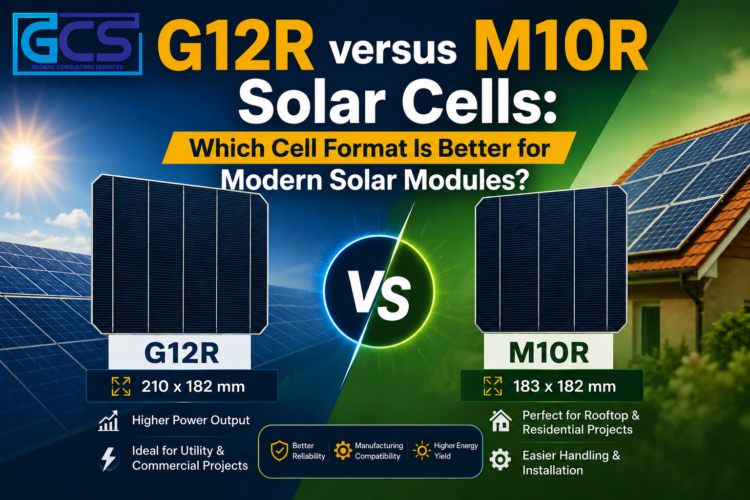
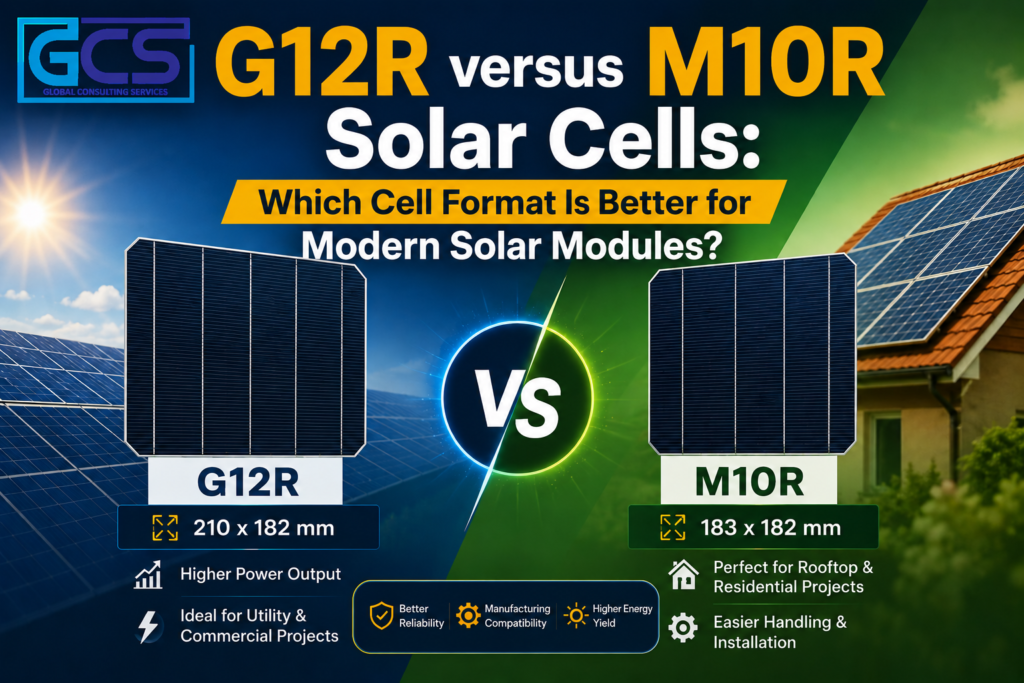
- G12R cells are made from a wafer that is about 210 millimeters by 182 millimeters.
- M10R cells are made from a smaller wafer that is about 183 millimeters by 182 millimeters.
The “R” in both names means that the cells have rounded corners. These rounded corners are designed to make the cells easier to make, reduce stress on the cells, and lower the risk of damage during production and transportation.
Even though the difference in size might seem small, it can make a difference in how the cells work electrically and how the modules are designed.
G12R v/s M10R: Key Specifications
Here are some specifications for G12R and M10R solar cells:
- Cell Size: G12R cells are 210 millimeters by 182 millimeters, while M10R cells are 183 millimeters by 182 millimeters.
- Active Cell Area: G12R cells have a larger active area, while M10R cells have a smaller active area.
- Current Generation: G12R cells can make more electricity, while M10R cells make a moderate amount of electricity.
- Module Power: G12R cells can make more power, while M10R cells make a bit less power.
- Typical Applications: G12R cells are often used for solar farms and commercial rooftops, while M10R cells are often used for residential rooftops and small commercial buildings.
The bigger active area of G12R cells allows them to catch more sunlight, which means they can make more electricity and more power.
Why Cell Size Matters
One of the advantages of G12R cells is that they have a bigger active area.
A bigger cell can catch more sunlight, which means it can make more electricity. This is because every bit of sunlight that hits the cell can be turned into electricity.
The process is simple:
Bigger cell area → More sunlight is caught → More electricity is made → More power is produced
Compared to M10R cells, G12R cells have about 14 to 15 percent more active area, which makes them attractive to companies that want to make high-power solar modules.
This is one reason why many modern solar farms are using these cells.
More Power Does Not Mean Efficiency
Some people in the solar industry think that a solar panel that can make more power is automatically more efficient.
This is not true. Power output and efficiency are two different things.
- Power output just means how much electricity a solar panel can make under standard conditions.
- Efficiency means how well the solar panel can turn sunlight into electricity.
A bigger cell like G12R might be able to make more power because it has a bigger area, but that does not mean it is more efficient.
There are many factors that can affect efficiency, including:
- The type of cell technology used
- The quality of the silicon wafer
- The surface passivation
Both G12R and M10R cells can be very efficient if they are made with advanced technologies.
The Importance of Rounded Corners
The “R” in G12R and M10R cells is important because it means the cells have rounded corners.
Traditional solar cells with sharp corners can develop cracks and stress during production and transportation.
Rounded corners can help reduce this problem.
The benefits of rounded corners include:
- Reduced stress
- Lower risk of cracks
- Better durability
This is especially important for companies that want to make sure their solar panels last a long time.
Manufacturing Benefits
One reason companies are quickly adopting G12R and M10R cells is that they do not require major changes to existing production lines.
Both types of cells have similar manufacturing characteristics, which means companies can switch between them easily.
This allows companies to make the transition to new cell formats faster and cheaper.
The result is:
- Lower production costs
- Less downtime
- Better scalability
Electrical Characteristics
G12R cells have a bigger active area, which means they can make more electricity.
This also means they require more careful electrical design.
Companies need to make sure the electrical components are optimized for the cells.
This includes:
- Busbar configuration
- Ribbon dimensions
- Junction box ratings
- Thermal management
If these components are not designed properly, the increased electricity can lead to electrical losses.
M10R cells, on the other hand, make less electricity, which makes electrical management a bit easier.
Which Solar Projects Benefit Most?
The choice between G12R and M10R cells depends on the solar project.
G12R Cells
G12R cells are well-suited for:
- Solar farms
- Commercial rooftops
- Industrial power plants
These projects need to make as much power as possible and want to keep costs low.
M10R Cells
M10R cells are better for:
- Residential rooftops
- Small commercial buildings
- Projects where space is limited
These projects need panels that are easy to handle and install.
Reliability Beyond Efficiency
People who buy solar panels are no longer just looking at efficiency.
They also care about:
- Long-term reliability
- Mechanical strength
- Thermal stability
The design of the cells can affect all these factors.
A well-designed solar panel combines good cell technology with good mechanical engineering.
This ensures the solar panel will work well for more than 25 years.
Future Trends in Solar Cell Design
The solar industry is moving towards making panels that are optimized for many different factors, not just efficiency.
Companies are trying to balance:
- Larger cell sizes
- More power
- Better reliability
- Lower production costs
Future innovations will likely combine technologies like TOPCon and HJT with optimized cell formats.
This will allow solar panels to make more electricity.
G12R versus M10R: Which One Should You Choose?
There is no one-size-fits-all answer to this question.
If you want to make as much power as possible for a big solar farm or commercial rooftop, G12R cells might be the better choice.
If you are working on a rooftop or a project with limited space, M10R cells might be better.
The best choice depends on the project and what you need.
Final Thoughts
The debate between G12R and M10R cells shows how the solar industry is changing.
It is no longer about making the most efficient solar panel.
Companies are now trying to optimize every aspect of solar panel design.
G12R cells show how bigger active areas can make more power, which is good for big solar projects.
M10R cells are still a good choice for residential and rooftop installations where size and weight matter.
As solar technology keeps getting better, the future will belong to solutions that balance performance, reliability, and cost.