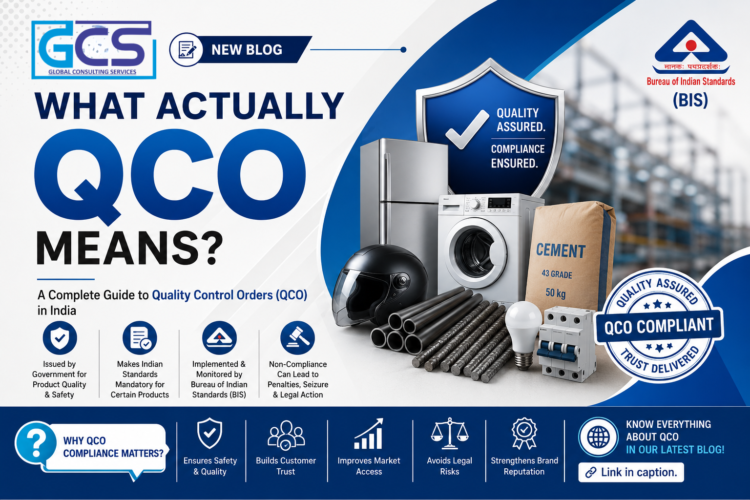
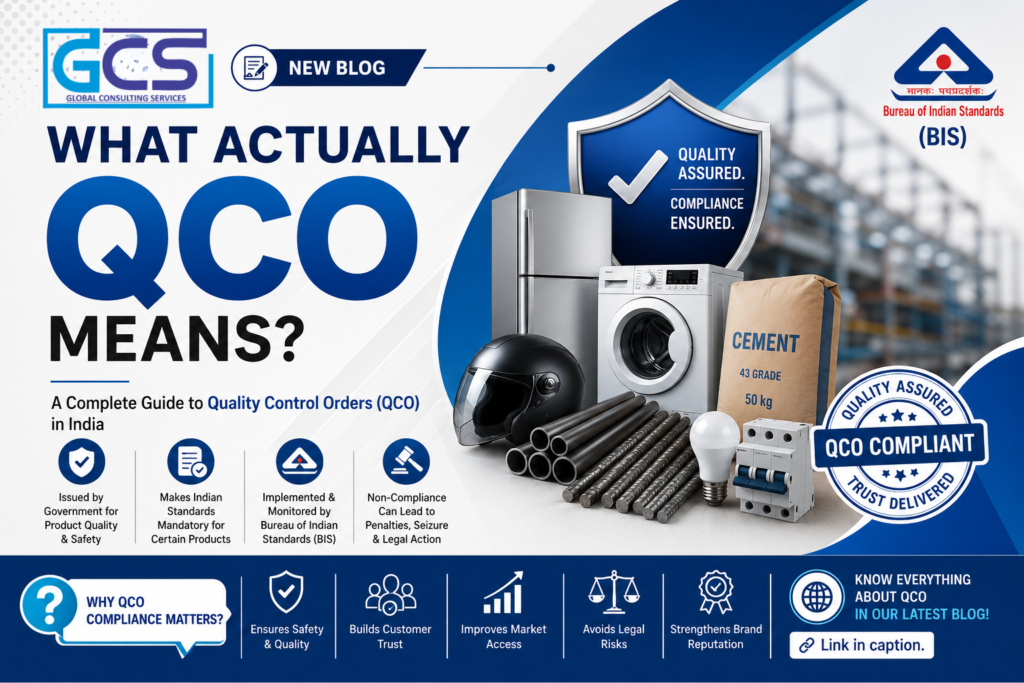
If you have recently started making products in India or you are planning to bring products into the market, you have probably seen the term Quality Control Orders (QCOs). It is mentioned in government notices and BIS regulations, but a lot of businesses still wonder what Quality Control Orders actually mean.
The answer is really simple.
A Quality Control Order (QCO) is a notice from the government that says certain products have to meet Indian Standards before they can be made, brought into the country, sold, or distributed in India.
In this guide, we will tell you everything you need to know about Quality Control Orders, why they exist, how they affect businesses, and what steps manufacturers and importers should take to follow the rules.
What is a Quality Control Order?
A Quality Control Order is a notice given by the Government of India under the Bureau of Indian Standards (BIS) Act, 2016.
The main goal of a Quality Control Order is to make sure that products in the market are good, safe, and work well.
When a Quality Control Order starts, products that it covers cannot be made, brought into the country, stored, sold, or distributed unless they meet the applicable Indian Standard and obtain the required BIS certification, if needed.
To put it simply:
A Quality Control Order makes a quality standard that is not required into a law that must be followed.
Why does the government give Quality Control Orders?
Quality standards are not made to create rules. They are made to protect consumers, industries, and the economy.
Some of the reasons the government gives Quality Control Orders include:
- Making sure products are good and safe for consumers
- Stopping the sale of fake products
- Helping manufacturers compete fairly
- Supporting the “Make in India” plan
- Making people trust products made in India
- Helping India sell products to other countries
- Protecting health and the environment
By making sure all products meet the same quality standards, the government ensures that products sold in India are reliable, safe, and made according to established rules.
Who gives Quality Control Orders?
Some people think that BIS gives Quality Control Orders, but that is not true.
Actually, Quality Control Orders are given by Ministries and Government Departments depending on the type of product.
For example:
- Ministry of Steel
- Ministry of Chemicals and Fertilizers
- Ministry of Textiles
- Ministry of Consumer Affairs
- Ministry of Heavy Industries
- Ministry of New and Renewable Energy
The Bureau of Indian Standards acts as the authority that makes sure people follow the rules by giving licenses and checking that products meet the standards.
How does a Quality Control Order work?
It is really straightforward.
Step 1: Government Notice
The ministry that is in charge publishes a Quality Control Order in the Gazette.
Step 2: Product Identification
The notice says which products are covered, which Indian Standard they must meet, when the order starts, and whether they need certification.
Step 3: Following the Rules
Manufacturers and people who bring products into the country must get the required BIS certification before the deadline.
Step 4: Checking the Market
After the order starts, authorities check products in the market to make sure they meet the rules.
Products that do not meet the rules may face penalties, be taken away, or not be allowed to be sold.
Which products are covered by Quality Control Orders?
Today, hundreds of products are covered by Quality Control Orders.
Some common categories include:
- Steel products
- Cement
- Electrical appliances
- Chemicals
- Solar PV modules
- Industrial valves
- Fasteners
- Pipes and fittings
- Toys
- Helmets
- Footwear
- Furniture
- Kitchen appliances
- Household electrical products
- Batteries
- Pressure vessels
The list keeps growing as the government introduces Quality Control Orders in different sectors.
Is BIS certification required under Quality Control Orders?
In most cases, yes.
Once a product is covered by a Quality Control Order, manufacturers and people who bring products into the country usually need to get the required BIS certification before selling the product in India.
Depending on the product, following the rules may involve:
- ISI Certification
- BIS CRS Registration
- Scheme X Certification
- Other BIS conformity assessment schemes
The certification needed depends on the product and the Indian Standard mentioned in the Quality Control Order.
Who needs to follow Quality Control Orders?
Quality Control Orders apply to businesses including:
- Indian manufacturers
- Manufacturers that export to India
- People who bring products into the country
- Brand owners
- OEM manufacturers
- Contract manufacturers
- Traders who deal with regulated products
Even if a product is made outside India, it must meet the Quality Control Order before it can be brought into the Indian market.
What happens if you ignore a Quality Control Order?
Ignoring a Quality Control Order can have legal and commercial consequences.
Some possible outcomes include:
- Stopping manufacturing activities
- Banning product imports
- Taking away products
- Heavy financial penalties
- Action under the BIS Act
- Cancelling licenses
- Losing customer trust
- Damage to brand reputation
For businesses, not following the rules often results in delays, extra costs, and disruptions to operations, making it better to follow the rules from the start.
Benefits of following Quality Control Orders
Although following the rules takes effort and documentation, the long-term benefits are worth it.
Businesses that follow Quality Control Orders enjoy:
- Increased customer trust
- Better product quality
- Easier access to the market
- A competitive advantage
- Reduced business risk
How can businesses prepare for a new Quality Control Order?
The best approach is to start getting ready well before the order starts.
A practical plan includes:
- Finding out if your product is covered by a Quality Control Order
- Determining the applicable Indian Standard
- Understanding the BIS certification scheme
- Preparing the required documents
- Arranging product testing at a BIS-recognized laboratory
- Submitting your application on time
- Addressing any issues raised during the certification process
- Getting your BIS license before the Quality Control Order starts
Planning ahead helps avoid last-minute delays that could interrupt manufacturing or imports.
How Global Consulting Services can help
Understanding Quality Control Orders is the first step. The real challenge is interpreting government notices, finding the appropriate certification scheme, coordinating product testing, and completing the BIS licensing process accurately.
At Global Consulting Services, we provide support for businesses that need BIS compliance. Our services include:
- Checking if a Quality Control Order applies
- Guiding BIS certification
- Supporting documentation
- Coordinating product testing
- Filing applications
- Working with authorities
- Helping manufacturers and importers with compliance from start to finish
Whether you are introducing a product in India or responding to a recently notified Quality Control Order, our team helps simplify the compliance process while reducing delays and administrative burden.
Conclusion
Quality Control Orders are more than regulatory notices. They are an essential part of India’s commitment to ensuring safe, reliable, and high-quality products in the market. Understanding what Quality Control Orders mean and staying updated with government notices is crucial for manufacturers, importers, and brand owners.
Instead of seeing Quality Control Orders as a problem, businesses should see them as a chance to improve product quality, build customer trust, and gain a competitive edge. With proper planning and the right compliance partner, meeting Quality Control Order requirements can become a smooth and strategic process.
If you are not sure whether your product is covered by a Quality Control Order or need help with BIS certification, seeking expert guidance can help you avoid delays and ensure complete compliance.