If you want to sell products in India whether you are a manufacturer or an overseas brand you need to think about BIS compliance.
The Bureau of Indian Standards is very important to make sure that products sold in India are good quality and reliable.
But most businesses get confused about what to do: should they go for BIS FMCS or BIS CRS?
At glance BIS FMCS and BIS CRS seem similar.
In reality they are very different in terms of process, scope and requirements.
Lets break it down in a way that makes sense.
To understand BIS FMCS and BIS CRS you need to know about BIS certification
BIS certification is not one thing. It has many schemes.
Each scheme is designed based on the type of product the risk level and what the industry needs.
For example products that are related to infrastructure. Are high-risk need stricter certification.
Electronics and IT goods follow a registration-based system.
This is where BIS FMCS and BIS CRS come into play.
What is BIS FMCS?
The Foreign Manufacturers Certification Scheme is for manufacturers who’re not in India.
If you are sending products to India that need ISI certification you need to use BIS FMCS.
In words: BIS FMCS means you get full certification your factory is inspected and your product gets the ISI Mark.
With BIS FMCS you get a BIS Licence your product has the ISI Mark, which’s a strong sign of quality in India and your factory is inspected by BIS officials.
BIS FMCS is used for products like construction materials, mechanical equipment, safety-critical electrical products and infrastructure-related goods.
Why is BIS FMCS so strict?
Because these products directly affect safety and infrastructure.
BIS makes sure that not just the product but the way it is made meets the standards.
What is BIS CRS?
The Compulsory Registration Scheme is an more commonly used BIS scheme.
It applies to both foreign manufacturers mainly for electronics and IT products.
In words: BIS CRS means your product is tested you register it and you get an R-number.
With BIS CRS your products are tested in a lab that BIS recognizes you submit documents online. You get a Registration Number.
There is no factory inspection at the start.
BIS CRS is used for products like phones, laptops, LED lights, power banks and electronic appliances.
Why is BIS CRS faster?
Because it only focuses on testing the product not inspecting the factory.
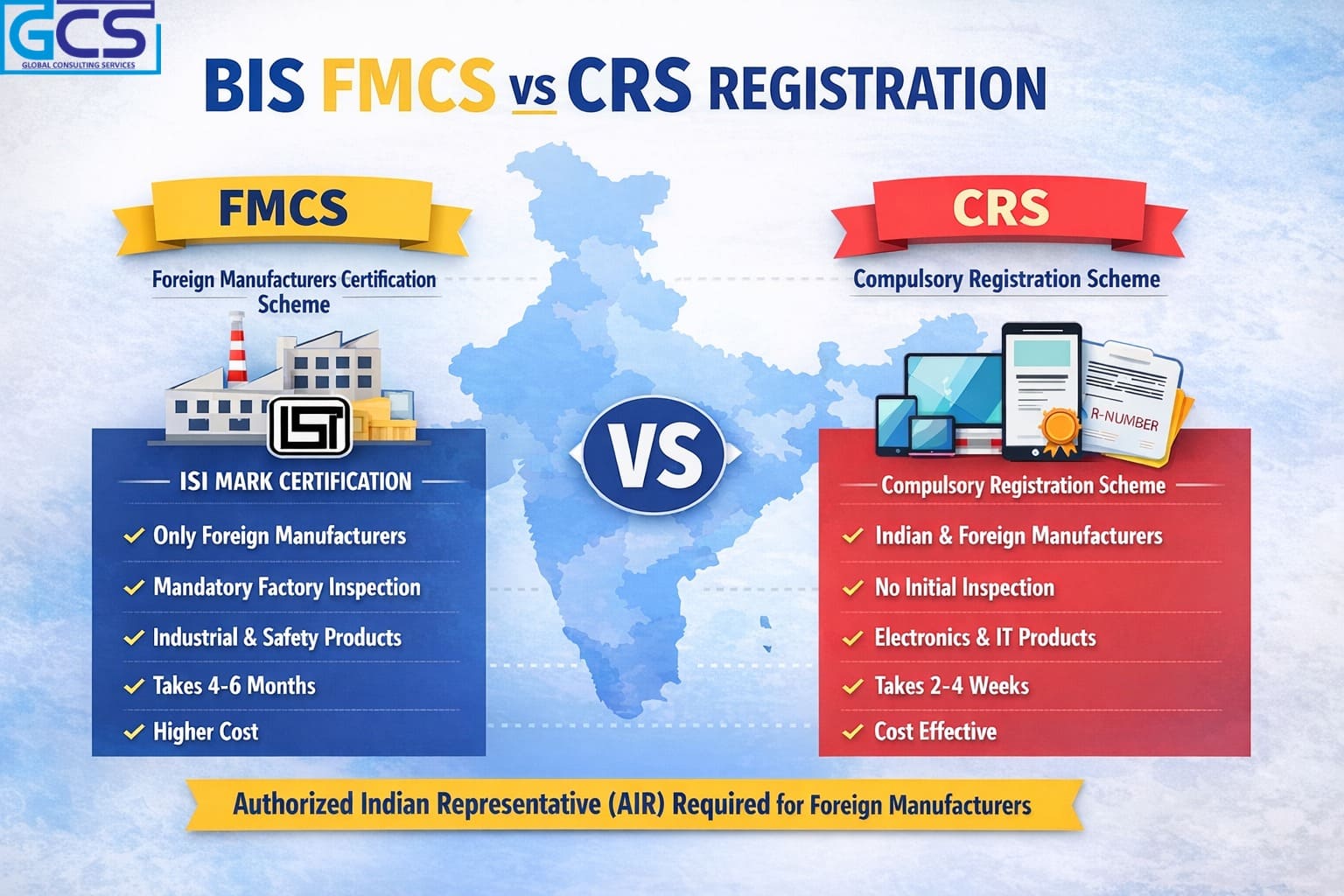
Now lets look at the differences between BIS FMCS and BIS CRS:
1. Who can use it
BIS FMCS is for foreign manufacturers
BIS CRS is for both Indian and foreign manufacturers
2. Type of approval
BIS FMCS gives you a BIS Licence and the ISI Mark
BIS CRS gives you a BIS Registration and an R-number
The ISI Mark is recognized more by the government.
3. Factory inspection
BIS FMCS requires an inspection by BIS officials
BIS CRS does not require an inspection
4. What products are covered
BIS FMCS is for safety-critical and infrastructure products
BIS CRS is for electronics and IT products
Think of it like this:
FMCS is for heavy-duty compliance
CRS is for fast-track compliance
5. How long it takes
BIS FMCS takes 4 to 6 months or more
BIS CRS takes 2 to 4 weeks
If you need it fast CRS is the way to go.
6. Cost and complexity
BIS FMCS is expensive and complex
BIS CRS is cost-effective and simpler
So which one should you choose?
The honest answer is: you don’t choose the type of product decides.
If your product needs ISI certification is safety-critical or is related to infrastructure you should go for BIS FMCS.
If your product is in the electronics or IT category you should go for BIS CRS.
Important requirement for foreign manufacturers
One thing to note: if you are a foreign manufacturer you need to have an Authorized Indian Representative.
This person acts as your contact in India handles communication with BIS and makes sure you comply with the rules.
Without an Authorized Indian Representative your application will not be processed.
Common mistakes businesses make
- assuming CRS applies to all products
- ignoring updates from BIS
- underestimating the paperwork needed
- not planning especially for FMCS
Why is BIS compliance good for your business?
It may seem like a hassle but its actually a good thing.
For businesses it builds trust and credibility reduces safety risks and improves how people see your products.
For consumers it ensures products are safe prevents low-quality imports and builds confidence in brands.
Conclusion
In the end both BIS FMCS and BIS CRS are important for product safety in India. They serve different purposes.
BIS FMCS is detailed and inspection-heavy for high-risk products.
BIS CRS is faster and simpler ideal for electronics.
Understanding the difference is crucial for entering the market successfully.
Today compliance is not about rules it’s, about trust, credibility and long-term success.